

Uzeyir Hajibeyli
"Asli and Karam"
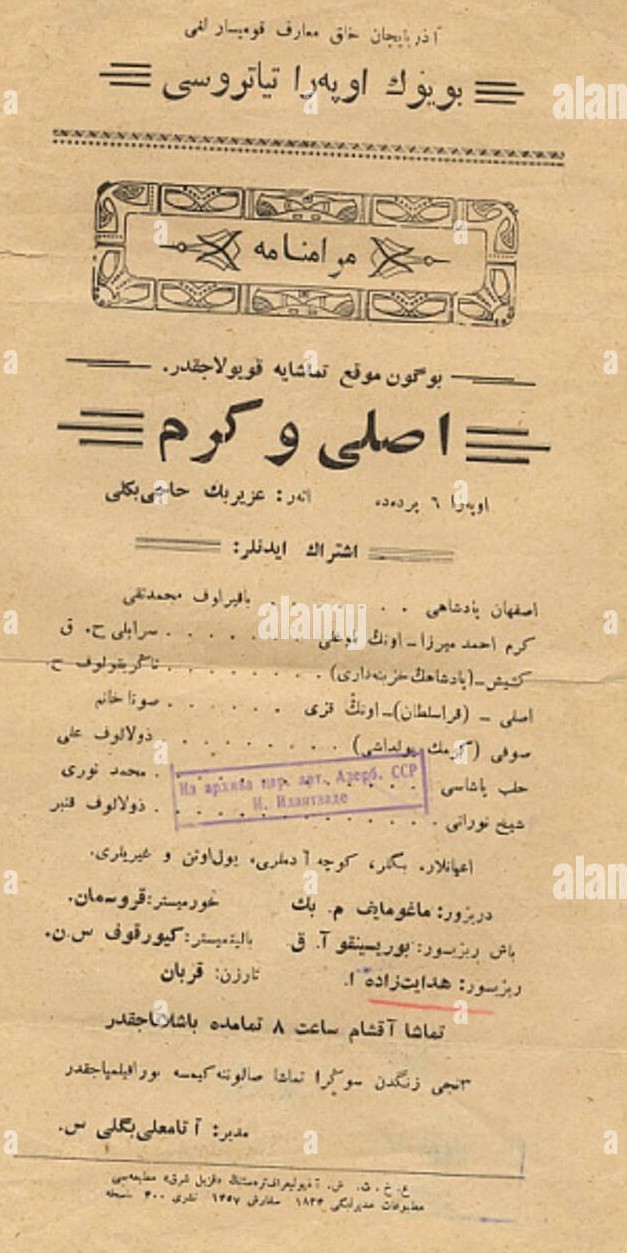 The opera "Asli and Karam", consisting of four acts and six scenes, premiered on May 18, 1912, in Baku, in the building of the current Academic Opera and Ballet Theater. Interestingly, that same year, a few months earlier, on March 10, 1912, another new opera by Uzeyir Bey, "Shah Abbas and Khurshidbanu," premiered at the Nikitin Brothers Circus. Two major operas were composed and performed in one year, which testifies to how hard and productive the composer worked, and how seriously and enthusiastically the opera artists approached their work.
Huseyn Arablinski directed the opera, and Uzeyir Bey conducted. Huseyngulu Sarabski played the role of Karam, and Ahmad Aghdamski played the role of Asli. The opera's heart-wrenching plot, masterfully crafted libretto, and beautiful, vibrant music that lifts the soul have won the hearts of listeners and spectators since the first performance and have been loved and appreciated.
Uzeyir Hajibeyli had experimented with two models of national opera and composed four operas before "Asli and Karam." The operas "Rustam and Sohrab" and "Shah Abbas and Khurshidbanu," which he created after "Sheikh Sanan", were also somewhat close to "Leyli and Majnun." In other words, although the author's original music predominated in these operas, mughams were still given ample space. However, Uzeyir Hajibeyli aimed to enter a new era in his operatic creativity and do something novel. This new dawn became the opera "Asli and Karam."
By addressing the theme of "Asli and Karam," Uzeyir Bey turned to a new source for the subject matter of his works, folk epics and ashug music. As a key factor, this innovation determined the novel stage of our national operas, which the composer established, and the new form structure. If mughams predominated in "Leyli and Majnun" and "Rustam and Sohrab, " in "Sheikh Sanan" and "Shah Abbas and Khurshidbanu," what we conventionally call "European-style" music was widely used. In "Asli and Karam," Uzeyir Bey, remaining true to his "innovative" beliefs, for the first time opened up an immense space for the "leitmotif", the "refrain," that is stable theme that characterizes the hero throughout the entire opera and constantly accompanies him, as well as the rhythms of ashug music and several elements characteristic of folk epics. In short, "Asli and Karam" became a new and innovative opera among our national operas.
One of the opera’s main merits and significant innovations was that the theme of the work was taken exclusively from Azerbaijani life. While Leyli and Majnun originated from Arabia, Sheikh Sanan from Balkh, Rustam and Sohrab from Iran, and Shah Abbas and Khurshidbanu from the Safavid realm, Karam is the beloved hero of Azerbaijani epics, the son of Ziyadkhan, the khan of Ganja. When composing the libretto, Uzeyir Bey presented Karam as the son of the Sultan of Isfahan, not as the son of the Khan of Ganja. This certainly can also be perceived as a theatrical method and tool used by the author to increase the impact of the stage play and make it appear larger in scale.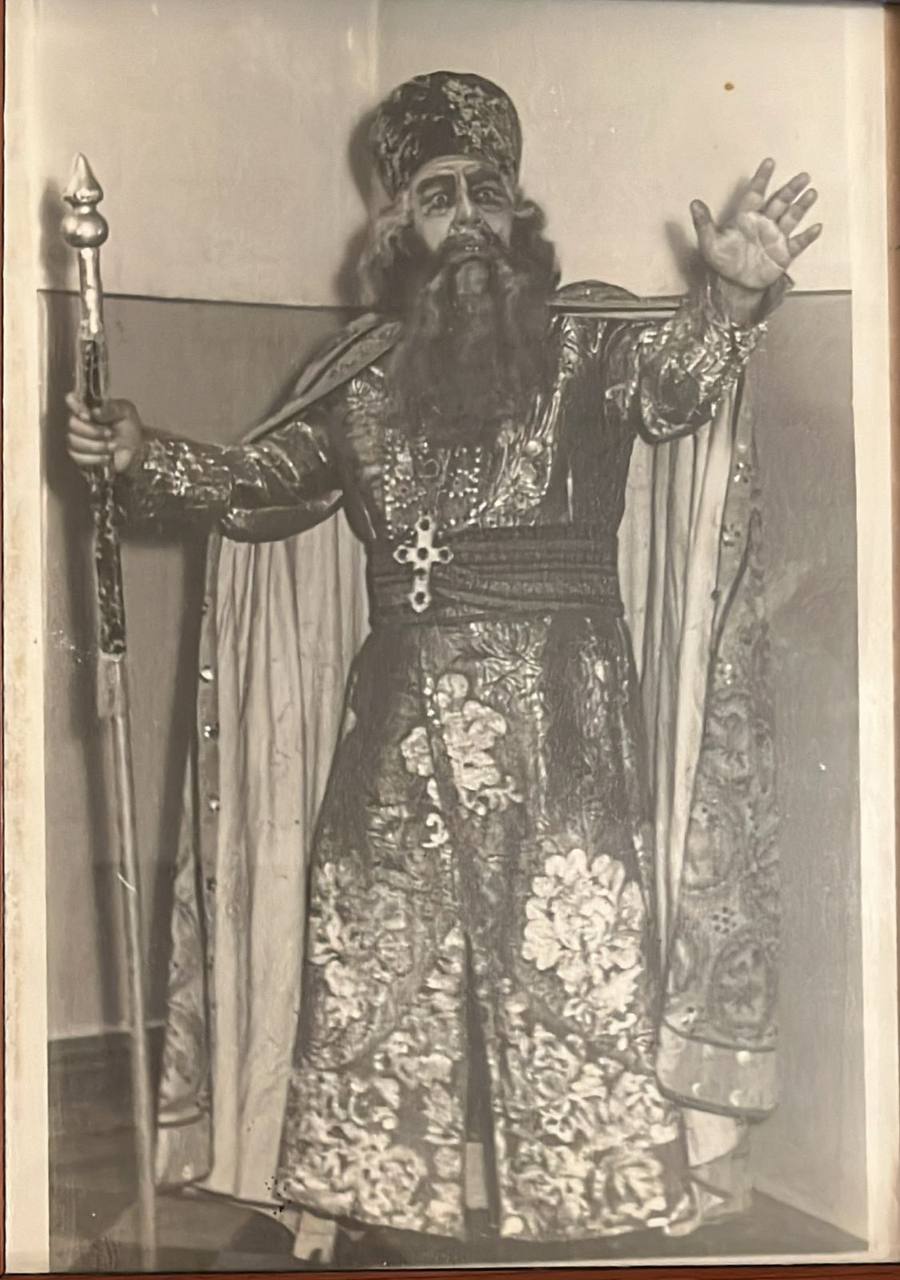
Karam's tragic love story, his wandering from place to place in pursuit of his beloved, composing heartbreaking poems, playing the saz, and his rise to the status of "hagg ashigi" (lit. truth lover) through divine power have been the stuff of legend among our nation for centuries. His poems and the saz melodies he composed continue to live in the Azerbaijani people's soul, blood, and memory to this day. By bringing Khan Karam to the opera stage, Uzeyir Bey drew attention to Azerbaijani epics and impelled their acquisition of new meaning, content, and interest in enriching our developing musical culture. Many stage plays that would later be created would draw on epics as a rich source.
A few years after its premiere, the opera was already performed outside Azerbaijan. It was staged in the Caucasus, Central Asia, Iran, and Turkey.
The newspaper "Vakht," published in Uzbekistan, wrote: "... The operas "Leyli and Majnun," "Asli and Karam," and the musical comedies "Arshin Mal Alan," and "If Not That One, Then This One," performed in Tashkent and other cities of Uzbekistan starting in 1916 were immensely popular with Uzbek audiences."
Rashid Yasemi's book "Contemporary Literature," published in Tehran, contains the following lines: "... At the end of the First World War... a group of Russian and Caucasian players (artists - S. F.) visited Iran... In particular, they first performed the Caucasian operettas "Arshin Mal Alan," "If Not That One, Then This One," and the opera "Asli and Karam" in Turkic, then translated them into Persian and performed them involving Turks who knew Persian. Their work progressed in a very pleasing manner."
Many talented artists have demonstrated their talents and skills on the stage of our national opera. After the unforgettable Huseyngulu Sarabski, the role of Karam was performed by such master artists as Huseynagha Hajibababeyov, Alovsat Sadigov, Abulfat Aliyev, Arif Babayev, Gulu Asgarov, and Janali Akbarov, and such wonderful singers as Gulkhar Hasanova, Sara Gadimova, Zeynab Khanlarova, Rubaba Muradova, Rasmiyya Sadigova, Nazakat Mammadova, and Gandab Guliyeva performed the role of Asli.
The opera has also had several productions over the years. Huseyngulu Sarabski, Aghakarim Sharifov, Huseyn Rzayev, Shamsi Badalbeyli as directors, Izzat Seyidova and Ayyub Fataliyev as artists, Hanafi Teregulov and Nijat Malikov as choirmasters, and Muslum Magomayev, Niyazi, Afrasiyab Badalbeyli, and Kazim Aliverdibeyov as conductors contributed to various productions of the opera "Asli and Karam."
The author edited the opera "Asli and Karam" and our other national operas and operettas over the years. It was due to objective reasons, such as the year-on-year expansion and perfection of the orchestra and choir in the opera house. There is even a contract signed with the opera house in the 1920s by Uzeyir Hajibeyli, stating that he would make new edits to the work. However, in 1957, the opera theater entrusted composer Nazim Aliverdibeyov with a new edition of "Asli and Karam." Nazim Aliverdibeyov, who profoundly assimilated Uzeyir Hajibeyli’s style, creative features, and musical heritage, completed this work.
Certainly, "Asli and Karam" also holds its honorable place in the magnificent "Uzeyir World" project, which encompasses the artistic, journalistic, and scientific work of Uzeyir Hajibeyli. Once again, we would like to highlight the first publication of the score of the opera "Asli and Karam."
We must especially acknowledge the dedicated efforts of Firangiz Alizadeh, the chair of the Azerbaijan Composers' Union and a People's Artist, who tirelessly contributed her creative and organizational talent to the creation of this score. Additionally, Kazim Aliverdibeyov, Honored Art Worker and Conductor of the Academic Opera and Ballet Theater, has invested significant effort in preparing the score as its current editor, after years of conducting this opera. We also recognize the invaluable contributions of People's Artist Janali Akbarov, who portrayed the role of Karam.
The publication of this score marks a new chapter for the opera "Asli and Karam," created by the renowned Uzeyir Hajibeyli. It will undoubtedly fill the hearts of all Uzeyir fans and everyone who wishes for the elevation of our culture with joy and delight. There will surely be many more such moments ahead.
Sardar Farajov
Director of the Uzeyir Hajibeyli House Museum, Honored Art Worker