

Uzeyir Hajibeyli
“If Not That One, Then This One”
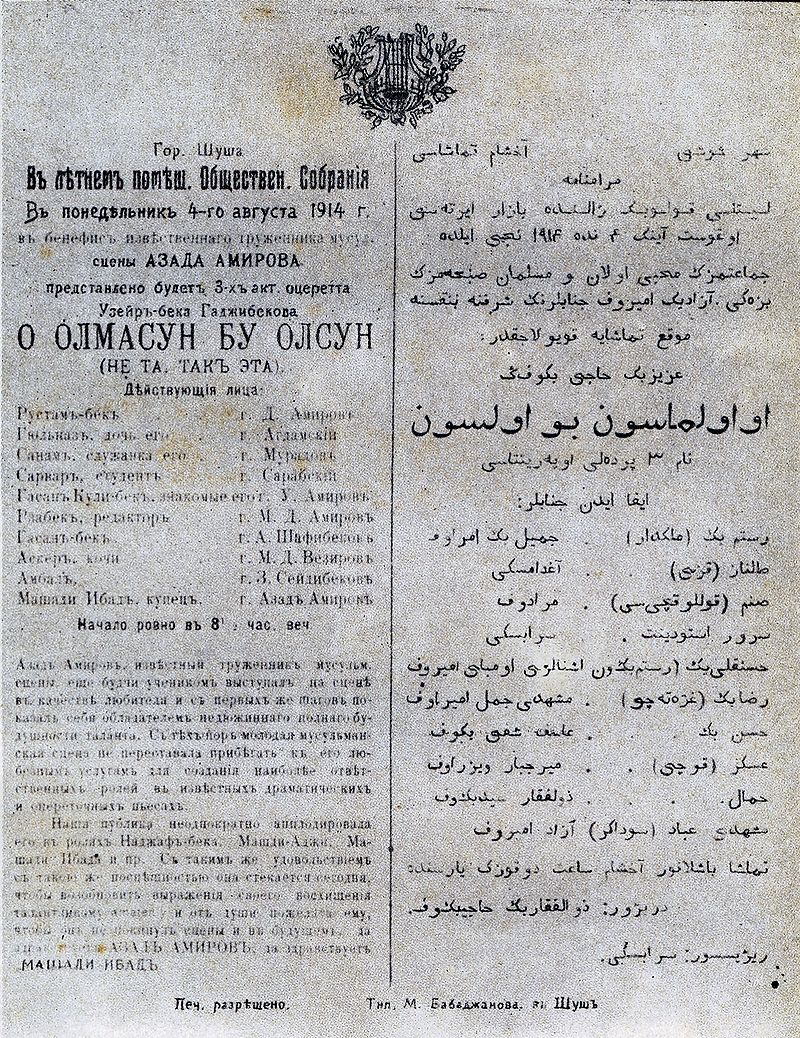 Uzeyir Hajibeyli was an incomparable composer and a great playwright. His comedies “The Husband and the Wife” (1909), “If Not That One, Then This One” (1910), and “Arshin Mal Alan” (1913) stand alongside the classic comedies of Mirza Fatali Akhundov and Jalil Mammadguluzadeh in the treasury of Azerbaijani culture. However, the most significant aspect of Uzeyir bey Hajibeyli’s comedies lies in the fact that, through his inexhaustible creative power, the artist succeeded in combining dramaturgy with music and laid the foundation for the genre of national musical comedy.
In Uzeyir Hajibeyli’s musical comedies, the characterization of roles through music, the creation of musical portraits, the setting of several dialogues to music, the use of choruses and dances, and the extensive presence of music in both dramatic and lyrical scenes are important features. At the same time, the literary text of Hajibeyli’s comedies possesses the same dramatic impact on stage independently. Notably, the comedy “If Not That One, Then This One” stands as the most brilliant example of Uzeyir Hajibeyli’s dramaturgy.
First and foremost, it should be noted that Uzeyir bey Hajibeyli, at the beginning of the 20th century, used a sharp “weapon” — laughter and satire — to criticize and expose the outdated beliefs, moral norms, and ignorance deeply rooted in the society he lived in, aiming to awaken the people and call them to struggle. He chose this original approach precisely to promote the progressive ideas of his time. The characters created by Hajibeyli also reflect the artist’s own desires and ideals, as well as his aspiration to beautify life.
Uzeyir bey’s musical comedy “If Not That One, Then This One” was created in 1910 and, over nearly a century, has become one of the most beloved works among the people. It is unlikely to find anyone among the Azerbaijani people who has not read, seen performed on stage, or watched a film of “If Not That One, Then This One”. It is no coincidence that almost every word of this work has become a popular proverb among the people. Many striking expressions from the comedy are used as aphorisms. At the same time, the music of the work has found its way to the hearts of the people and has become widely memorized. This distinction, undoubtedly, is not given to every work. In particular, the fact that several meaningful expressions associated with the main character, Mashadi Ibad, have arisen among the people proves this. For example, phrases such as “Growing weak like Mashadi Ibad in old age”, “Come on — that hen won’t walk anymore!”, “Why are you losing your mind like Mashadi Ibad?”,“Don’t act like Mashadi Ibad”, and others belong to this category. Uzeyir Hajibeyli has a distinctive artistic style. He thoroughly studied all the characters of the comedy in real life, portrayed them in various situations, and was able to reveal their personalities. The audience sees the life of the noble merchant class here without any embellishment, laughs at them, and despises them. In this work, Hajibeyli created a true gallery of negative types. Who are his characters? Rustam bey, a nobleman who has lost his standing in society, become bankrupt, and immorally marries his young and beautiful daughter Gulnaz to the old Mashadi Ibad in order to gain money; Rza bey, a journalist who makes money by writing lies and slanders in the press; Hasangulu bey, an unprincipled nationalist looking out for his own benefit; Hasan bey, a gossiping and quarrelsome intellectual; Gochu Asgar, who keeps those around him under fear with his petty jealousy and weapons; and, of course, Mashadi Ibad.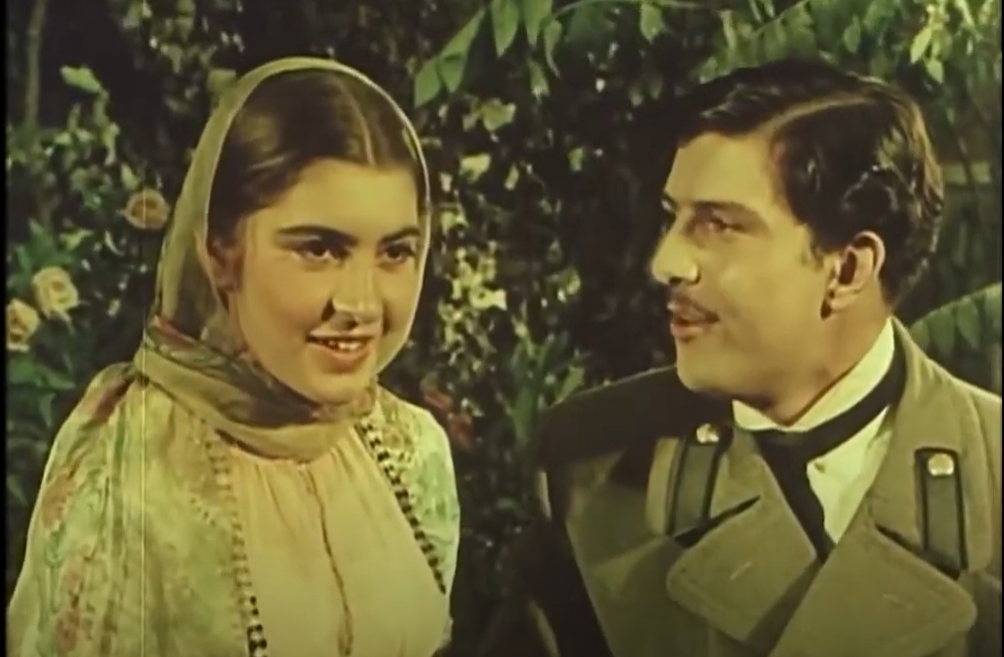
Mashadi Ibad, a wealthy merchant, fully embodies the corrupting essence of money and the role it plays within society. In his worldview, wealth signifies superiority over others and the possession of power. Money, in his understanding, is the fundamental determinant of human existence, rendering even the most just social laws powerless in its presence. Mashadi Ibad frequently reiterates the following statement: “There is a proverb that says: If not that one, then this one. Naturally, what harm is there in that? Let youth be absent—as long as there is money. Money is such a force that it can make an old man young, while the lack of it can turn a young man old”.
Mashadi Ibad, an uneducated and ignorant individual, nonetheless attempts to present himself as educated, cultured, and refined when the situation demands. His repeated references to the “science of virtue”, his mention of the book “Tarikhi-Nadir” (“The history of Nadir”), and his strategic use of proverbs and sayings to serve his own purposes are all directly connected to this self-fashioned image.
Since Mashadi Ibad views the meaning of life through the lens of trade, he engages in a serious negotiation with Rustam bey and effectively purchases his daughter Gulnaz for two thousand manats. As events grow more complicated and his fear of losing both Gulnaz and the money increases, Mashadi Ibad, in his own words, is once again forced to “spend a heap of money”. His attitude toward family, love, and life clearly reflects the perspective of a tradesman—one who views all relationships as transactions.
The skillfully crafted character of Mashadi Ibad plays a pivotal role in revealing all the negative figures in the play. It is difficult to imagine Rustam bey, Gochu Asgar, Hasangulu bey, Rza bey, or Hasan bey independently of Mashadi Ibad. Even the intervention of Hambal (Porter) character in the events is tied to him. Mashadi Ibad is a unique figure who unites the negative characters and stands at the very center of the comic developments in the work.
However, in contrast to all these grotesque figures, the play also presents another world: the pure and sincere realm of two young people—Sarvar and Gulnaz—who are in love with each other. They strive toward a new life and endeavor to overcome the obstacles standing in the way of their future happiness. They understand that they must take charge of their own destinies; thus, they bravely rise up against those with outdated beliefs and, in order to defeat them, even resort to clever schemes. The servant Sanam also supports them in this struggle, defending Gulnaz—whom she loves like a daughter—and helping the young couple in their pursuit.
“If Not That One, Then This One” is a classic example of creating artistic character through language. Mashadi Ibad, Rustam bey, Hasangulu bey, Hasan bey, Rza bey, Gochu Asgar, Hambal, and Sanam are all such characters. Each of them possesses a distinct manner of speech, which is precisely why Uzeyir Hajibeyli was able to craft vivid and lifelike portraits of them.
Uzeyir Hajibeyli describes events, settings, objects, people, their clothing, and movements in such a way that everything vividly comes to life before the reader’s eyes. Through the use of original, precise, and contextually appropriate language, he is able to express his ideas fully and clearly. What stands out in his style is a remarkable simplicity, naturalness, and persuasive realism.
Music plays an important dramaturgical role in the comedy. All musical numbers function as natural elements of the onstage action and significantly contribute to the characterization of the figures. Two distinct spheres of character and intonation are clearly manifested, highlighting the contrasting content of the work and bringing its inner tensions to the forefront.
First and foremost, it is necessary to highlight the musical portrait of Mashadi Ibad. In the merchant’s well-known song, which begins with the line “Though I may be old,” the conceited and elderly Mashadi Ibad boasts that he is the equal of a hundred young men. Uzeyir Hajibeyli makes use of the melody from the folk dance “Uzundere” (“Long Valley”) in this piece. The fact that such a vibrant and expressive dance melody is sung by Mashadi Ibad lends the moment a caricature-like quality. It becomes immediately clear to the audience that, despite his talk of deep human emotions and love, Mashadi Ibad’s behavior and his song can only evoke disgust in the heart of the young woman he intends to marry. This stands out as one of Hajibeyli’s notable uses of satire. Moreover, this song serves as a remarkably effective means of revealing Mashadi Ibad’s character.
The other negative characters in the musical comedy are not portrayed individually to the same extent but are primarily characterized through choral scenes. These choruses are typically an organic part of the spoken dialogue scenes and are distinguished by their vibrant humor.
The world of lyrical characters occupies a distinct and exceptional place in the play. The duets of Sarvar and Gulnaz reflect their feelings of love and their romantic, dream-like emotional state. In the musical numbers that characterize these protagonists, the composer makes use of ghazals by Fuzuli, thus enriching their portrayal with poetic and emotional depth.
Thus, the artistic characters of the musical comedy “If Not That One, Then This One” reflect, like a mirror, the contradictions of Azerbaijani society at the time. It is precisely because Uzeyir Hajibeyli portrayed the contradictions of life truthfully and sincerely, and depicted human psychology with great skill, that this work continues to retain its educational and moral significance. Even today, it remains a subject of interest not only in Azerbaijan but also in a number of countries around the world.
“If Not That One, Then This One” is a musical comedy with a rich stage history. The work has undergone several revisions and has been staged multiple times. It was first performed on April 25, 1911, at the Mailov Brothers Theatre (present-day Azerbaijan State Academic Opera and Ballet Theatre). In this premiere, Mirza Agha Aliyev played the role of Mashadi Ibad, Huseyngulu Sarabski portrayed Sarvar, and Ahmad Aghdamski appeared as Gulnaz, among others. Uzeyir Hajibeyli conducted the performance himself. In the years that followed, many prominent actors took part in various productions of the comedy. The play has also been translated into numerous languages and staged in theaters across Transcaucasian cities, as well as in Turkey, Bulgaria, Yemen, and other countries.
In 1956, based on the musical comedy, the “Azerbaijanfilm” studio produced a film of the same name. The screenplay was written by Sabit Rahman, the director was Huseyn Seyidzadeh, and the music editor was Fikrat Amirov.
Uzeyir Hajibeyli’s musical comedy “If Not That One, Then This One” continues to be warmly received by audiences to this day.
Associate Professor of Baku Music Academy, Jamila Hasanova.