

Uzeyir Hajibeyli
Romance - ghazal "Without You"
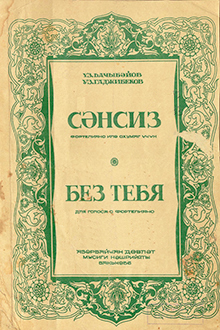 Romance is a musical genre that represents the most beautiful expression of noble feelings. A romance is a musical composition intended for vocal and instrumental (often piano) accompaniment. The first creator of the romance genre in Azerbaijan was the composer Asaf Zeynalli. Another type of romance genre exists in Azerbaijan, which is also referred to as romance-ghazal. Uzeyir Hajibeyov created the first examples of this genre, even nationalizing its name by calling it "musical ghazal." In connection with the 800th anniversary of Nizami Ganjavi, a thinker, poet, and genius of 12th-century classical Azerbaijani poetry, Uzeyir Hajibeyli composed vocal works such as "Without You" (1941) and "Sweetheart" (1943) based on two ghazals by the poet. In doing so, he laid the foundation for the romance-ghazal genre. The composer had considered writing the musical ghazal "Without You" before World War II. In the early 1940s, he contemplated composing music for seven poems inspired by the images of the beauties in Nizami Ganjavi's Seven Beauties. Uzeyir Hajibeyli intended to depict the musical portraits of the characters, their psychological states, personalities, feelings, inner worlds, and spiritual beauty in vocal miniatures. But ultimately, he could only compose and complete two romances-ghazals: "Without You" and "Sweetheart."
The ghazal genre has been one of the most popular forms of Azerbaijani literature and music for centuries. Uzeyir Bey first turned to Fuzuli's ghazals in his creative work. Initially, Fuzuli's poem was sung in Hajibeyli's opera "Leyli and Majnun," and later, the poet's ghazals were performed in the operettas "Arshin Mal Alan" and "If Not That One, Then This One."
The romance-ghazal "Without You" starts with an instrumental intro. In this work, Hajibeyli kept the plot and idea of Nizami's ghazal and combined poetry with music. Uzeyir Hajibeyli skillfully used the tradition of blending literary and musical forms, as well as the organic link between ghazal and music. The composer connected this literary genre with music, integrating ghazals into musical compositions, and established the foundation for a new genre and form in Azerbaijani vocal music - the musical ghazal.
The romance "Without You" was performed by singers such as Bulbul and Muslum Magomayev. Bulbul was its first performer. Singer M. Magomayev performed the romance with great skill in the film "Nizami," making an author's edit.
If you observe the line of movement in the melody of the ghazal "Without You," you will notice the form of declamation. The melody's conversational style is achieved by repeating a single note and returning to it after a small leap. Uzeyir Hajibeyli could translate the sadness and grief expressed in Nizami's ghazal into musical language using such a melodic line. The phrase "Without You" has different tones in the ghazal and is sung with various intonations. These include sad, hopeless, questioning, and joyful tones. The "Segah" magam in the ghazal "Without You" creates a beautiful harmony with U. Hajibeyli's music, the poetry of Nizami, and the philosophical sadness of these verses.
The first part of the romance-ghazal begins in the "Shikasteyi-fars" section. The second part is written in the expanded "Arag" section of the "Segah" magam's vocal row, where, while transitioning to another tune, a tendency toward another magam, "Bayati-Shiraz," is evident. Including the same magam and tune in the middle of the ghazal creates a certain contrast, adding new vibrancy to the work. Uzeyir Hajibeyli composed the romance "Without You" on the bahr of "Ramal," one of the ghazal bahrs.
The romance was first published in Baku in 1944. It is also performed with the accompaniment of symphonic, folk instruments, and pop orchestras.
Lyrics:
Every night brings me sorrow, grief, and calamity without you,
Every breath I take is wasted in that hour without you!
I swore an oath to your enchanting presence, believe me,
My soul burns with your absence; I have no strength without you!
How can I search for another beloved, oh delicate angel?
I know you, too, have said: “There’s no need for a beloved without you!”
You rule over my heart; my heart has become your servant,
You are precious, while I am of little worth, nothing, a disaster without you!
What use is my sight if I cannot seek you, and my luck is absent?
Nor do I have the courage to flee; I am lost without you!
If you are assured of Nizami, my dear,
I searched day and night, yet there is no peace without you!