

Uzeyir Hajibeyli
The worldwide fame of "Arshin Mal Alan"
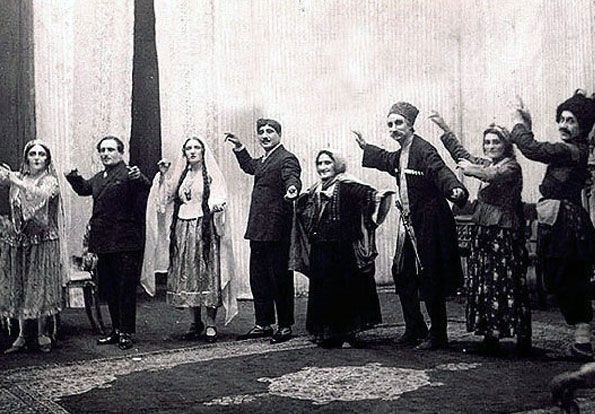 The musical comedy "Arshin Mal Alan" by the genius Uzeyir Hajibeyli has been touring the world's screens and stages for more than a century. The operetta has been translated into 80 languages worldwide, including French, German, Polish, English, Arabic, Persian, Chinese, Georgian, Bulgarian, Ukrainian, and Belarusian. The musical comedy is being shown in 187 theaters in 76 countries, in cities such as New York, Paris, London, Sofia, Berlin, Istanbul, Tehran, Cairo, Warsaw, and Beijing. "Arshin Mal Alan" is played in 13 states in the United States, 16 cities in Georgia, 17 cities in Bulgaria, 17 cities in Poland (1,500 times), 28 cities in Russia, and 8 cities in China.
Several feature films have been made based on the musical comedy "Arshin Mal Alan." It was first filmed in 1916 by director B. Svetlov at the Pirone brothers' "Filma" joint-stock company initiative. H. Sarabski played the role of Asgar, A. Aghdamski played the role of Gulchohra, M. Aliyev played the role of Suleyman Bey, and A. Huseynzadeh played the role of Soltan Bey. Since the film is silent, folk instruments accompany it, and J. Garyaghdioghlu and other singers sang arias from the musical comedy.
In 1917, G. Belyakov, who came from Petersburg, re-filmed "Arshin Mal Alan." However, he did not consult with the author or even get his permission when filming the work. The film was released on April 20, 1917, and was shown for only 2 days. This film, which involved amateur actors, was poorly received and was removed from the screen at Hajibeyov's insistence. In 1937, "Arshin Mal Alan" was screened in the United States by R. Mamoulian, a director of Armenian descent, but Hajibeyov's name was not mentioned in the film. Stalin, who attended the Tehran Conference of the Allied Powers in 1943, was outraged upon seeing the film, which R. Mamoulian attributed to Armenians. Despite the difficult war conditions, he urgently ordered the "Arshin Mal Alan" to be filmed in Azerbaijan with the participation of Uzeyir Bey.
The black-and-white musical film, shot in 1945 at the Baku Film Studio (now "Azerbaijanfilm"), gained worldwide recognition. Sabit Rahman wrote the script, R. Tahmasib and N. Leshchenko directed the production, A. Atakishiyev and M. Dadashov were cinematographers, and Niyazi was the music editor.
The leading roles were played by R. Behbudov (Asgar), L. Javanshirova (Gulchohra), A. Huseynzadeh (Soltan Bey), M. Kalantarli (Aunt Jahan), L. Abdullayev (Vali), I. Afandiyev (Suleyman Bey), F. Mehraliyeva (Telli), and others. For the film "Arshin Mal Alan," U. Hajibeyov, R. Tahmasib, N. Leshchenko, R. Behbudov, L. Javanshirova (Badirbeyli), A. Huseynzadeh, M. Kalantarli, and L. Abdullayev were awarded the Stalin Prize in 1946. Uzeyir Bey was awarded the Stalin (State) Prize twice in 1941 and 1946 for the opera "Koroghlu" and the film "Arshin Mal Alan"...
In 1965, the musical comedy "Arshin Mal Alan" was re-screened in Baku. The director of this color musical film was T. Taghizadeh, the scriptwriters were M. Dadashov and T. Taghizadeh, and the music editor was F. Amirov. The main roles were played by H. Mammadov (Asgar), L. Shikhlinskaya (Gulchohra), H. Yagizarov (Suleyman Bey), N. Malikova (Aunt Jahan), Kh. Hajiyeva (Asya) and S. Ibrahimova (Telli).
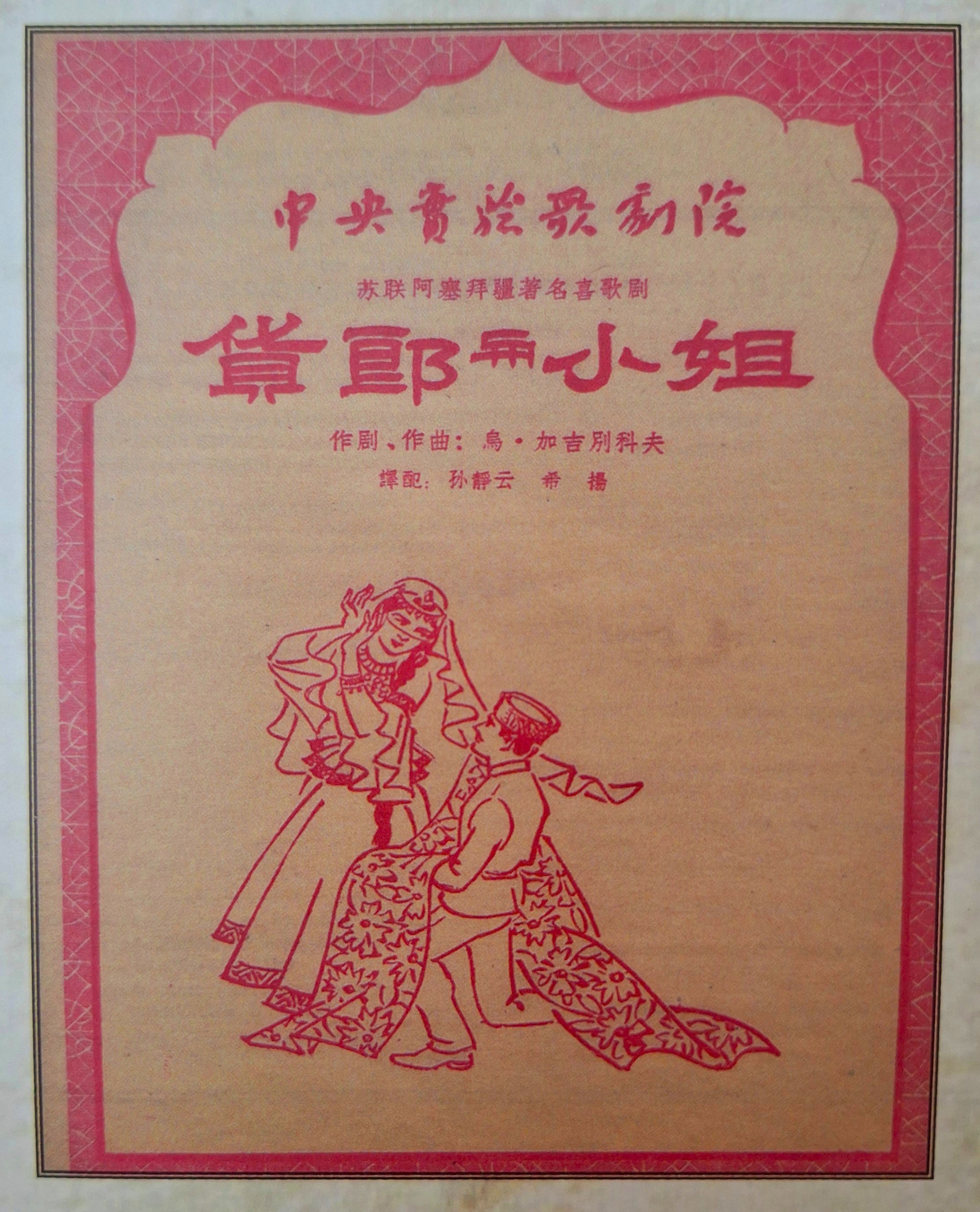
In 1959, the operetta "Arshin Mal Alan" was first performed in Chinese at the Tianqiao Theater in Beijing, becoming the first foreign operetta in the Chinese capital. The Chinese National Opera has performed this work more than 300 times in various cities nationwide. A Chinese version of the film "Arshin Mal Alan" was also made by the personal order of Mao Zedong, and a Chinese-language disc of this musical comedy was released. In 2010, the Azerbaijan State Academic Opera and Ballet Theater and the Chinese National Opera staged another performance of the operetta "Arshin Mal Alan."
In 1972, the Melodiya company produced a gramophone recording of the musical comedy in Russian, Azerbaijani, and Persian.
It was performed on September 27, 2006, in Vienna, the capital of Austria, considered the center of world music. Austrian artist Michael Schnack was also impressed by the music of the work from the very first hearing and decided to stage it at the Vienna Chamber Opera Theater. The prominent Azerbaijani musician, Professor Farhad Badalbeyli, assisted him in this work. The creative director and conductor M. Schnack staged the work in a modern setting without touching a single note of Uzeyir's music. The performers appear mostly in contemporary costumes, except the kalaghayi in his production. One of the most interesting features of the play, perhaps the most important, is that the performers are not actors of just one theater, or even one country. They were invited from different countries: Aisha Lindsay (USA) as Gulchohra, Ramin Dustdar as Asgar, Lin Yakus Russ (Belgium) as Soltan Bey, Murielle Stadelmann (France) as Aunt Jahan, Johano Luto (Canada) as Asya, Kaoko Amano (Japan) as Telli, and Wolfgang Sheila (Germany) as Vali. The musicians are from Slovakia.
One of the beauties of the performance is the involvement of Azerbaijani tar player Vusal Iskandarzadeh in the orchestra. 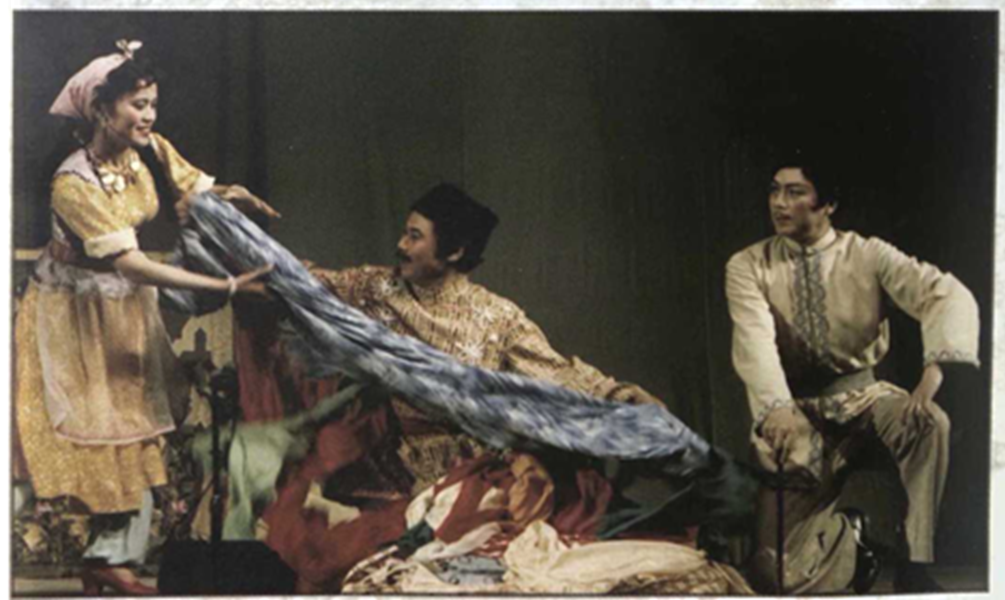
Production director Michael Schnack conducted the performance on the first day, and Azerbaijani conductor Azad Aliyev conducted on the second day.
 Another significant event occurred on the day of Vienna’s first "Arshin Mal Alan" performance. The inauguration of the statue of Uzeyir Bey took place on September 27, 2006, in the capital of Austria, the cradle of world music.
In 2013, the operetta "Arshin Mal Alan" was successfully performed on the stage of the world's largest and most famous opera house, the Dorothy Chandler Pavilion, in Los Angeles, USA, on the occasion of the work's 100th anniversary. More than 3,000 spectators attended the performance. The play is the first staging of "Arshin Mal Alan" on this scale and in this form in an English-speaking environment, especially in the United States.
American composer and producer Michael Schnack produced the operetta, and well-known opera singers from the United States performed the roles. The operetta's songs were performed in Azerbaijani, and the dialogues were in English. The prestigious Hollywood Orchestra, based in Los Angeles, performed the operetta’s music skillfully. In the final wedding scene of the play, the performers took to the stage in Azerbaijani national costumes. The backdrop of the wedding scene featured images of the castle gates of the city of Shusha, the cradle of Azerbaijani music, various historical monuments, and the nature of Garabagh.