

Uzeyir Hajibeyli
“Shah Abbas and Khurshidbanu”
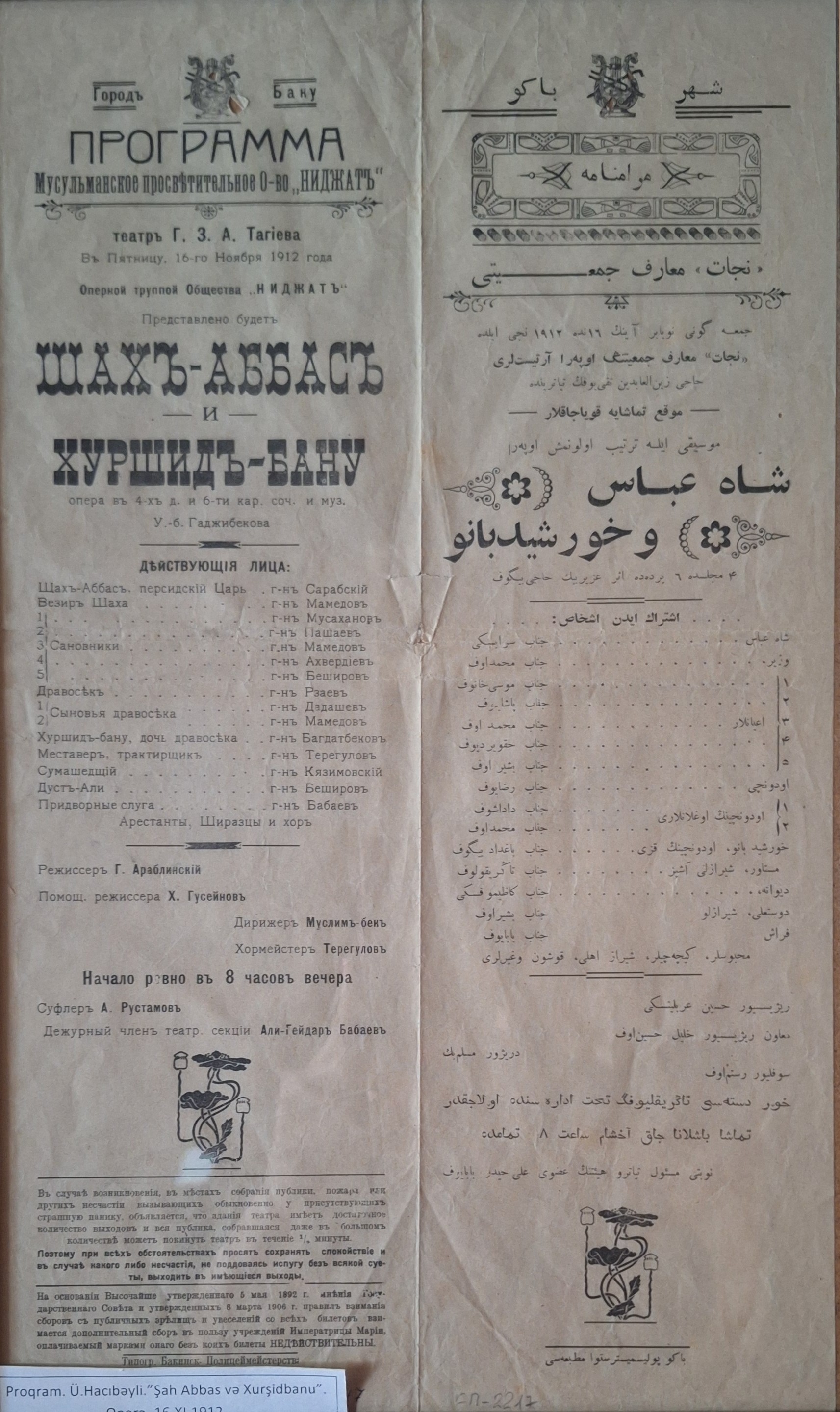 “Shah Abbas and Khurshidbanu” is the fourth mugham opera by Uzeyir bey Hajibeyli. The libretto of the work also belongs to Uzeyir bey Hajibeyli. The opera is based on motifs of Azerbaijani folk tale and consists of 4 acts and 6 scenes.
The opera was first performed on March 10, 1912 at the Nikitin Brothers’ circus. The director of the production was Huseyn Arablinski, and the conductor was Muslim Magomayev. The cast included: Huseyn Sarabski (Shah Abbas), Ahmad Aghdamski (Khurshidbanu), Huseyn Teregulov (Mastavar), and others. The opera was staged on the Azerbaijani scene until the 1930s.
Unlike previous operas, this work concludes with a happy ending. The main heroine is a simple woodcutter girl who defeats the ambitious and fame-seeking Shah. In the opera, good triumphs over evil, and sublime love prevails. Like in previous works by Hajibeyli, here mugham music is widely used. However, in this work, the composer significantly expanded the material, indicating his creative development. Hajibeyli managed to create music that accurately reflects the individual traits of the characters.
The character of Shah Abbas in the opera was the most successful part. For the first time in mugham opera, a traditionally classical aria is heard (in the first act). Nevertheless, the aria clearly embodies the national modal and intonation foundation. The aria also presents great interest from a dramaturgical point of view: the character of Shah Abbas is fully revealed – he is portrayed as a dreamy, poetic person with deep feelings, as well as a decisive and authoritative ruler. The two-tier content of the aria – on one hand lyrical and soft, on the other hand march-like, reminiscent of the rhythms of the mugham “Heyrati”. This aria of Shah Abbas later became the basis for the aria of Shah Aslan in the opera by M. Magomayev “Shah Ismayil” and played an important role in shaping Hajibeyli’s future opera style.
The opera also features an aria by Khurshidbanu in the first act and a part for Mastavar, both composed with original music of the great composer. Hajibeyli’s characteristic musical style combined with new musical expressions significantly expanded his compositional techniques and contributed to the opera’s great success.
The work was performed in various cities across the Caucasus and Iran. The libretto was translated into Persian. Unfortunately, the materials of 17 manuscripts have not been preserved. The opera remained in the repertoire of the Azerbaijan State Opera and Ballet Theater named after M.F. Akhundov until the late 1920s.