

Uzeyir Hajibeyli
“Koroghlu”
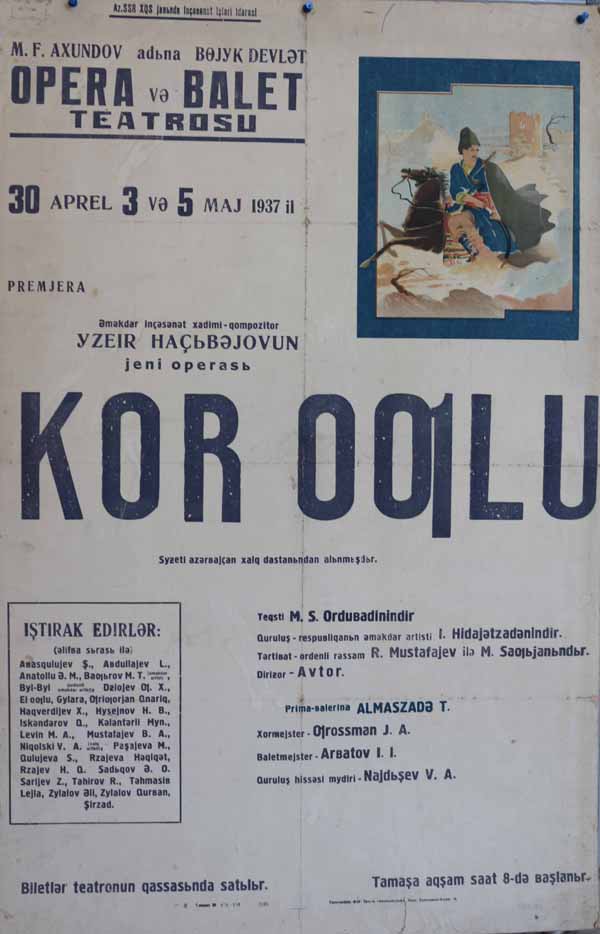 Azerbaijani culture and art, with their rich history, have made significant contributions to the world cultural heritage. The opera “Koroghlu” by the great composer Uzeyir Hajibeyli holds a special place among these historical achievements in the development of Azerbaijani national opera. This revolutionary epic was composed based on the “Koroghlu” dastan (traditional epic poem), which reflects the struggle of Azerbaijani peasants in the 16th-17th centuries. Uzeyir bey deeply studied folk music and skillfully combined Russian and Western musical traditions in creating this work.
The origin of the opera “Koroghlu” is very interesting. Uzeyir bey pondered for many years about composing the opera “Koroghlu”. In 1919, at the age of 34, while resting with his family in the Qajar Highlands of Georgia, Uzeyir bey Hajibeyli saw the Koroghlu fortress there. Every day he came near this fortress and admired its grandeur. On a subsequent visit to the fortress, he overheard an elderly ashiq reciting the “Koroghlu” dastan from memory. Uzeyir bey approached and listened attentively. He was so captivated by the ashiq’s performance that he decided on the spot to immortalize the “Koroghlu” dastan through the language of music.
The opera “Koroghlu” is based on historical events that took place in 16th century Azerbaijan. The folk epic “Koroghlu”, which is widely known not only in Azerbaijan but also throughout the South Caucasus, Central Asia, Turkey, and Iran, forms the foundation of the opera’s plot. The music of the opera reflects the historical destiny, character, psychology, and overall worldview of the Azerbaijani people.
The plot of the opera is as follows: In the mountainous region of Azerbaijan, the wealthy feudal lord Hasan khan rules. His cruelty terrorizes the oppressed peasants. Hasan khan awaits his friend, the Turkish feudal lord Ehsan pasha. He intends to present his guest with the best horse from his stable as a gift. To this end, he sends Ibrahim khan to the elderly minstrel Ali with the horse’s reins. Angered by Ali’s supposed deliberate act of driving the horse’s reins into the pasture, the khan orders the minstrel’s eyes to be gouged out. Rovshan, the beloved ashiq (folk bard) of the peasants and Ali’s son, is informed by his beloved Nigar about this new crime committed by Hasan khan. From this point on, Rovshan becomes known as “Koroghlu” (the son of a blind man). He retreats to the mountains with the peasants and raises a rebellion against the exploiters, terrorizing the feudal lords with his courageous attacks. Hasan khan realizes he cannot defeat Koroghlu alone and forms an alliance with Ehsan pasha. To celebrate this alliance, he organizes a banquet at the palace. Hasan khan plans to send a large army against Koroghlu, but the palace jester mocks this idea and proposes his own plan. To capture Koroghlu, it is enough to steal his beloved horse Qyrat, which will compel Koroghlu himself to come to the palace after the horse. Hasan khan approves the jester’s proposal. Hamza bey agrees to carry out this cunning plan on the condition that Hasan khan gives him Koroghlu’s beloved Nigar. 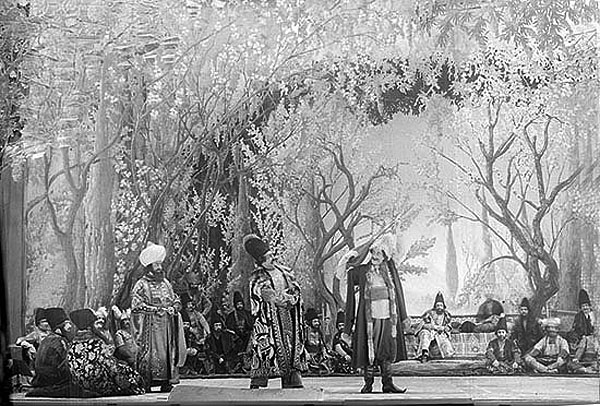 Hasan khan consents. Aware of the enemies’ intentions, Nigar sends her brother Eyvaz to Chanlibel to warn Koroghlu. In the mountains of Chanlibel, the rebels celebrate their free and independent life. They solemnly greet their beloved hero Koroghlu after another victory over the khan’s troops. During the festivities, the traitor Hamza bey, disguised as a traveler seeking shelter, pleads for asylum. That very night, using the storm and lightning, he steals Koroghlu’s beloved horse Qyrat, entrusted to him. Hamza bey brings the legendary Qyrat to Hasan khan, who hosts a banquet to mark the occasion. During the palace festivities, Koroghlu dressed in ashiq attire, enters singing folk songs. When he sees Qyrat, he becomes so absorbed in singing that he does not notice Hamza bey’s arrival. The traitor Hamza bey recognizes Koroghlu and informs Hasan khan. Koroghlu is captured and tied to a tree. Nigar is brought by the order of Hasan khan. Hasan khan tells Nigar that from now on she belongs to Hamza bey. The khan’s men also capture Nigar’s brother Eyvaz on the road to Chanlibel. In anger, Nigar opposes Hasan khan’s crimes. In response, Hamza bey breaks his sword over Nigar’s head. Koroghlu breaks his chains, kills Hamza bey, mounts his horse, and escapes. Hasan khan arrests Nigar, Eyvaz, and Polad, who helped Koroghlu escape, and orders their execution. Preparations for the execution are made in the town square. A crowd gathers, angry at the khan’s cruelty. Koroghlu enters the square with his warriors, frees the prisoners, and the people greet their hero and savior, celebrating victory.
Uzeyir Hajibeyli, the founder of Azerbaijani opera, worked on the famous and beloved “Koroghlu” opera from 1932 to 1936. Hajibeyli created “Koroghlu” based on the original motifs of the folk epic “Koroghlu”, dedicated to the people’s struggle for freedom. The librettists of the opera were Heydar Ismayilov and Mammad Said Ordubadi. The poetic text of the libretto belongs to M. S. Ordubadi. Hajibeyli himself participated in writing the libretto and made various changes. It is very interesting that the opera and libretto were written simultaneously. Since “Koroghlu” is a folk epic, it has reached us in various versions. However, Hajibeyli turned to the most original variant of the epic to instill freedom and heroism in his dear people. In conversation with M. S. Ordubadi, Hajibeyli said: “You know that the heroic image of Koroghlu has been lost among various versions. They portrayed Koroghlu, a steadfast rebel, as a medieval scoundrel and womanizer. Therefore, in the opera we are writing, we must clarify the political and social content of the Koroghlu era. Our people must see Koroghlu as a strong hero, a famous organizer of rebellion of his time, who fought against feudal lords on stage”.
Hajibeyli, by creating for the first time in Azerbaijani music the genre of the epic-heroic opera, brought innovation to Azerbaijani operatic art. Drawing upon Azerbaijani folklore and internalizing the spirit of the dastan, the innovative composer set himself, in his own words, the following task: “While working on “Koroghlu”, I aimed to create a national opera in form by utilizing the achievements of contemporary musical culture. “Koroghlu” contains all the elements typical of operatic art — arias, duets, ensembles, recitatives, etc. However, all of these are based on Azerbaijani musical folklore. I did not take ready-made melodies from the people. I only studied the foundations of folk creativity. “Koroghlu” has been and is still praised by ashiqs. Therefore, the prevailing style in the opera is the ashiq style. All the elements characteristic of an opera work are present in “Koroghlu”, but they are all built upon Azerbaijani musical folklore — namely, mugham”.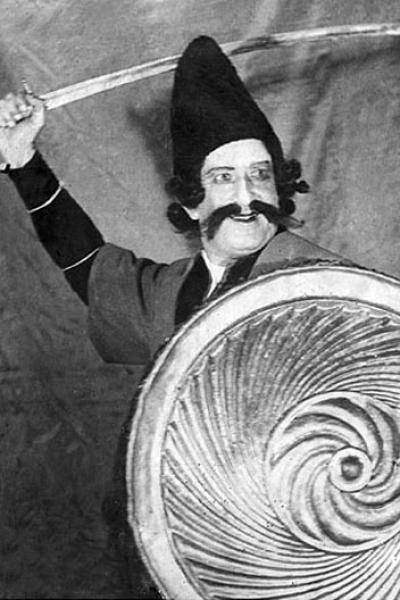
The symphonic language of Uzeyir Hajibeyli’s opera “Koroghlu” is remarkably rich and evocative. In an innovative approach, Hajibeyli integrated traditional Azerbaijani instruments—tar, balaban, and zurna—into the symphonic orchestra, thereby enhancing the timbral diversity and expressiveness of the opera’s orchestration. The composer himself emphasized the irreplaceable role of these instruments, particularly the tar, stating: “What is expressed by national instruments, especially the tar, cannot be substituted by any other instrument”.
The five-act opera “Koroghlu”, which played a significant role in the development of Azerbaijani national opera, centers on the people and their representatives as its principal characters. In this regard, it stands alongside the operas of great Russian composers such as M. I. Glinka, A. P. Borodin, and M. P. Mussorgsky. The image of the people is most prominently portrayed in the first, third, and fifth acts. These acts include dances and choral scenes that vividly depict the heroism of the Azerbaijani people. At the beginning of the act, the people are presented as oppressed in the chorus “This beautiful nature, this cheerful view”, then as enraged in “We must rise up today”, and finally as rebellious in “Let rebellion rise from every corner”. In the third act of the opera, Hajibeyli creates a powerful image of a joyful and triumphant people through the renowned “Chanlibel” chorus, the “Jangi” dance, and the “Oath” chorus. Koroghlu’s love for Nigar is expressed through lyrical arias, among which “I have loved you, my dear Nigar” is one of the most beloved.
The musical characterization of “Koroghlu” is predominantly shaped by the features of ashiq (folk minstrel) music. This is primarily due to the fact that, as Uzeyir Hajibeyli himself noted, the “Koroghlu” epic has traditionally been performed by ashiqs. The songs in the opera, which hold significant dramaturgical importance, are composed in the fourth act in the ashiq genre—particularly the “Gozallama”(a traditional Azerbaijani ashiq song genre characterized by lyrical praise of beauty and admiration)—as well as the “Shikeste” (a classical Azerbaijani mugham and ashiq genre noted for its melancholic and highly ornamented melodic patterns, expressing deep emotional and lyrical content), which is a fusion of mugham art and ashiq tradition.
The heroic-patriotic idea of the opera “Koroghlu” finds its fullest expression in its overture. The symphonic music of Azerbaijan also traces its origins to the overture and symphonic sections of “Koroghlu”. The overture was added to the opera later; its absence was the only drawback in the original version. To maintain tradition in operas written in the style of European symphonism, Hajibeyli included this world-renowned and beloved overture in the opera. The overture, a rare artistic gem, further propelled the worldwide fame of the “Koroghlu” opera. The significance of “Koroghlu” in the development of Azerbaijani music is immense, extending beyond the opera genre to include symphonic and ballet genres as well.
The staging of the opera “Koroghlu” marked the beginning of a new era in Azerbaijani theatre. The opera’s first performance took place in 1937 at the M. F. Akhundov Opera and Ballet Theater. The production was directed by Ismayil Hidayatzadeh, with Rustam Mustafayev as the chief artist, and conducted by Uzeyir Hajibeyov himself. The role of Koroghlu was performed by Azerbaijan’s great singer Bulbul, who masterfully embodied the character and by performing the role more than 400 times, transformed it into a symbol of national heroism. The role of Nigar was played by G. Isgandarova, and Hasan khan was portrayed by M. Baghirov. As the director of “Koroghlu” Ismayil Hidayatzadeh successfully fulfilled several important tasks, demonstrating his creative talents at a high level.
The first performance of the opera “Koroghlu” achieved unprecedented success, with numerous reviews and articles published in the press praising Uzeyir Hajibeyli’s extraordinary artistry. The work and its production received high acclaim. With this masterpiece, Uzeyir bey succeeded in elevating Azerbaijani opera art to the level of world culture.
The opera was performed during the Azerbaijani Culture and Art Decades in Moscow in 1938 and 1959. In 1941, Uzeyir bey was awarded one of the highest state honors of the time—the Stalin Prize—for this work. Azerbaijani artists presented “Koroghlu” in Iran in 1941. Between 1965 and 1975, the opera was showcased at the "Transcaucasian Music Spring" festivals. When performed in Russian, the role of Koroghlu was long regarded as one of the best interpreted by Azerbaijan’s People’s Artist Aleksandr Drozdov. Following Bulbul, this role was performed by USSR People’s Artist Lutfiyar Imanov and Honored Artist Adil Malikov. In recent years, young tenors working at the Opera and Ballet Theatre, Honored Artists Hasan Enami and Samir Jafarov, have taken on the role of Koroghlu on stage.
The opera "Koroghlu" has been translated into Turkmen, Uzbek, and Armenian, and staged in Ashgabat (1938), Yerevan (1942), and Tashkent (1950). In 2009, upon the initiative of TURKSOY and as part of an international project, Uzeyir bey’s “Koroghlu” opera was restaged. The project involved artists from Azerbaijan, Turkey, Kazakhstan, Kyrgyzstan, Tatarstan, and Bashkortostan. The performance of “Koroghlu” was presented in Bishkek, Ankara, Almaty, and Baku.
Uzeyir Hajibeyli’s principal contribution in creating this monumental opera lies in his ability to align Azerbaijani opera art with classical traditions without subordinating it to existing operatic methods, instead connecting those traditions with the foundations of his native folk art. Thanks to Hajibeyli’s attention to and care for the demands of the popular audience, the innovations he implemented had a profound impact not only on the development and renewal of Azerbaijani music art but also on the global evolution of musical art.
The opera “Koroghlu” is considered the highest peak and masterpiece of Uzeyir Hajibeyov’s creative legacy. Today, musicians around the world draw inspiration from this work to produce compositions of the highest caliber.