

Uzeyir Hajibeyli
“Sheikh Sanan”
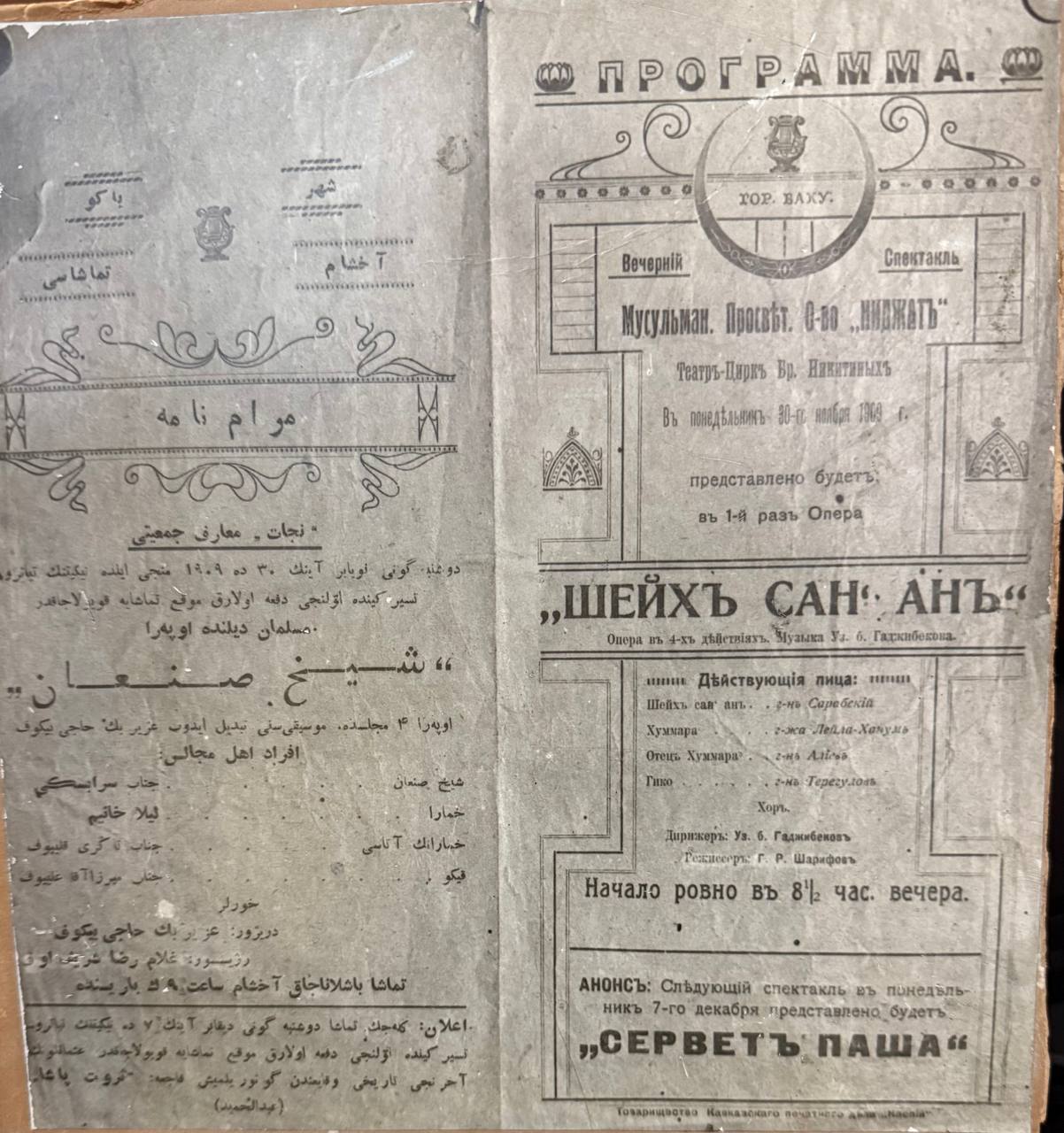 “Sheikh Sanan” is the second opera written by the Azerbaijani composer Uzeyir Hajibeyli. It consists of five acts and its libretto is based on the eponymous folk epic written by Hajibeyli himself.
In May 1909, Hajibeyli traveled to Tiflis and became engaged to Malak Khanum. During a walk near Mount Sanan in Tiflis, Hajibeyli came across the tomb of Sheikh Sanan, which inspired him to write the opera “Sheikh Sanan”.
The opera tells the story of the tragic love between two young individuals who follow different religions. “Sheikh Sanan” was first performed on November 30, 1909 (December 13 by the new style) at the Nikitin Brothers’ Circus.
On the day of the premiere of the opera “Sheikh Sanan” in Baku, there was heavy rain. The mud outside the opera house made it impossible to walk. The audience turnout was lower than expected, and the performance turned out to be unsuccessful – those who did attend were dissatisfied. However, there were also those who enjoyed the opera, as the music performed by the orchestra sounded enchanting. Some newspapers wrote that the music of “Sheikh Sanan” was fascinating the hearts.
The director of the production was H. Sharifov, and the conductor was Uzeyir bey Hajibeyli. The main roles were played by H. Sarabski (Sheikh Sanan), Leyla Khanum (T. Bogatko; Humar), H. Teregulov (Humar’s father). However, the staging fate of the opera turned out to be unsuccessful and it was never performed again.
Publications in the press of that time (“Seda”, “Teraggi”, “Hagigat”, “Kaspi”, “Baku”, etc.) partially explained the reasons for the failure. Mehdi bey Hajinski, who first introduced Russian-speaking readers to the legend of “Sheikh Sanan” in 1907, published an article under the pseudonym “Avara” after watching the opera, in which he wrote: “The opera ‘Leyli and Majnun’ gave the young composer the opportunity to create a new opera ‘Sheikh Sanan’. Preserving the main idea of the legend – ‘love knows no boundaries’, the young composer wrote beautiful music for it” (“Kaspi”, December 2, 1909, No. 270). In the reviews of arts figures and journalists who attended “Sheikh Sanan”, there were ecstatic assessments: “extraordinarily beautiful melody of the opera” (“Hagigat”, May 26, 1910, No. 118), “very beautiful music” (“Seda”, December 2, 1909, No. 45), “beautiful songs” (newspaper “Reklama”, in Russian), as well as expressions like “composed with magnificent music” (“Seda”, October 25, 1909, No. 15).So why did the staging fate of the opera “Sheikh Sanan” turn out to be unsuccessful?
Contemporaries of Uzeyir bey Hajibeyli, as well as researchers, explain this by the weakness of the opera’s libretto. Indeed, the libretto was weak. The play was not based on the libretto that Uzeyir bey Hajibeyli had been working on for two years. From sources, it becomes clear that during the work on the opera, Uzeyir bey entrusted the poet from Derbent Mirza Samandar to adapt the poem “Sheikh Sanan” into a poetic form. H. Abbasov, who in his memoirs writes that Mirza Samandar was invited to Baku by the order of Uzeyir bey Hajibeyli, spent three months there, adapted the poem into verses, and immediately handed them over to Uzeyir bey (H. Abbasov. “My memories”, Baku, 1968, p. 30), was a direct witness to this. However, it can be assumed that for some reason, perhaps under someone’s influence, Mirza Samandar shortly before the premiere took back his verses, and Uzeyir bey hastily replaced the verses in the libretto with fragments selected from oral folklore. Contemporaries also pointed to other reasons for the opera’s failure on stage, such as “European style of music”, “unpleasant sound of the Jewish choir”, “Leyla Khanum’s indifference to Muslim tunes”, and others.
For a long time in the history of the creative biography of Uzeyir bey, only one phrase about his opera “Sheikh Sanan” was mentioned: the musical material of the work was destroyed by the author himself. However, it is known that Uzeyir bey Hajibeyli began working on this opera again in 1911 and planned to write a new libretto. This was reported by the newspaper “Kaspi” on May 8, 1911.
Professor Ramazan Khalilov notes: “Uzeyir bey loved to rest every year in a picturesque place near Tiflis, which was called “mountain Koroglu”. I also often visited him there. Once I asked him: “When you tore up ‘Sheikh Sanan’, did you regret it?” He replied: “I destroyed the opera on paper, but not in my head. When the time comes, I will use it.” And it happened later. The musical material from the opera “Sheikh Sanan” was used in creating the opera “Koroglu”. It is interesting that the composer, while creating “Koroglu”, relied on “Sheikh Sanan”. Uzeyir bey worked on the opera “Koroglu” in the years 1932-1936. And this work became not only a new milestone in the history of Azerbaijani opera art, but also a new era in Azerbaijani art in general. The opera “Koroglu” became the main support, the foundation for the further development of the opera genre and the pinnacle of the composer’s creative path.