

Uzeyir Hajibeyli
"Rustam and Sohrab"
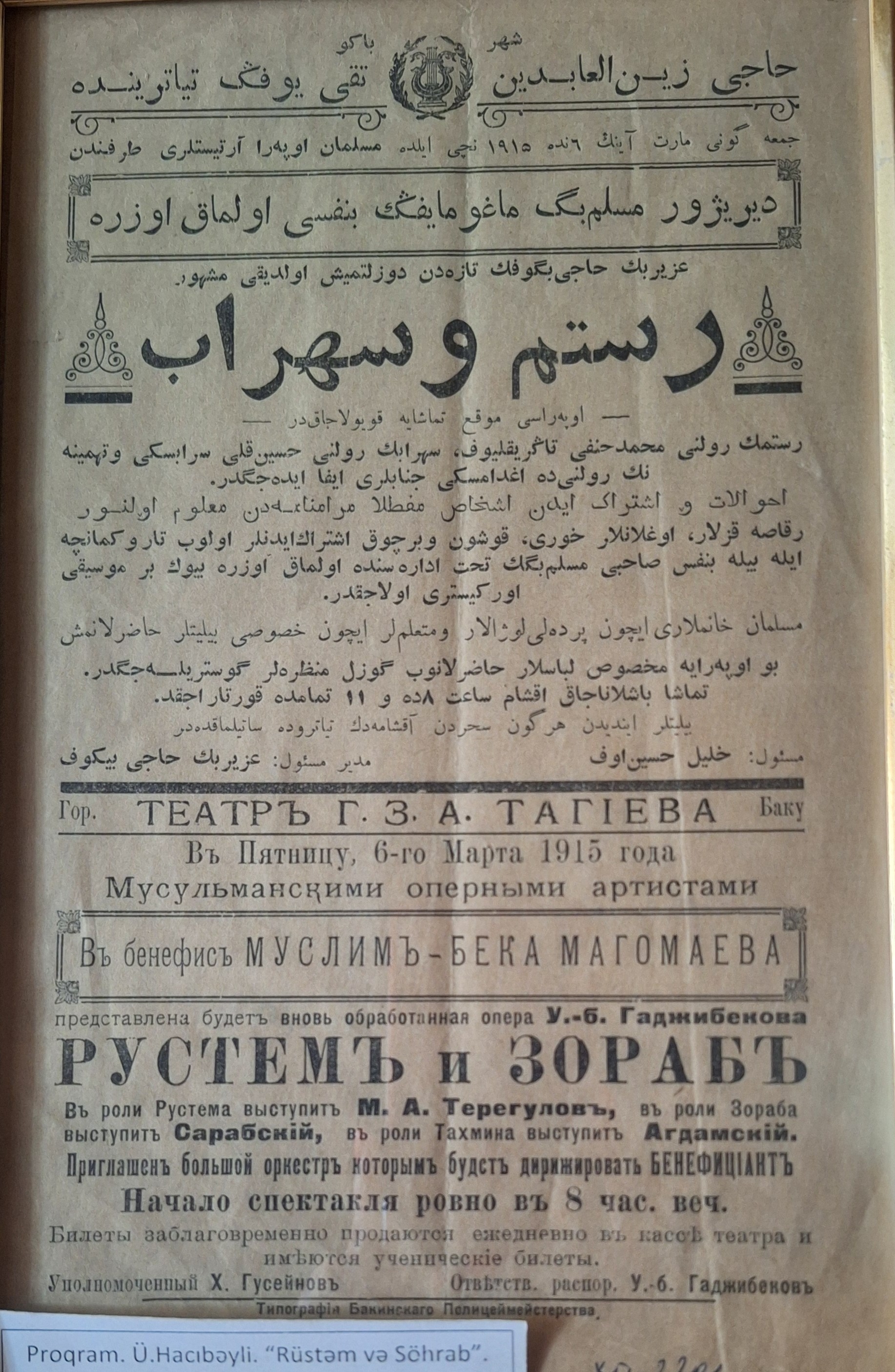 The genius composer Uzeyir Hajibeyli drew the content of nearly all his works from widely known folk stories, epics, legends, and tales. As the creator of the first opera in the Muslim East, he wrote his next major work in 1910, the opera "Rustam and Sohrab," inspired by the themes of the epic poem "Shahnameh" by the prominent Persian-Tajik poet Abu'l-Qâsem Ferdowsi (934–1020). "Rustam and Sohrab" is considered the most tragic tale within Ferdowsi's "Shahnameh." In this story, a father and son confront each other in battle without recognizing one another, ultimately resulting in the tragic moment where the father accidentally kills his son. The narrative of this work captures the extraordinary and intense conflicts faced by its heroic characters, reflecting a romantic grandeur rooted in folklore. Consequently, Hajibeyli minimized mugham scenes in this opera, emphasizing the music throughout his composition.
The opera "Rustam and Sohrab," created by Uzeyir Hajibeyli as an inspiration from this work, was the third mugham opera of its time. This four-act opera features a rich literary text composed of verses written in aruz meter. There have been various opinions regarding whether Uzeyir Bey wrote the libretto. Research has resolved the debates about the libretto’s authorship, revealing that some poetic verses are attributed to the poet-ghazal writer Buzovnali Azer.
The first information about the opera "Rustam and Sohrab" was published in 1910 in an issue of the "Gunash" newspaper.
The opera premiered on November 25, 1910, at the Taghiyev Theater in Baku, with Huseyngulu Sarabski as stage director and Hajibeyov as conductor. Huseyngulu Sarabski (Sohrab), Ahmad Agdamski (Tahmina), M. H. Teregulov (Keykavus), and others played the leading parts. According to the press, the play was not a success. Therefore, Uzeyir Hajibeyli took it off the stage.
After some revision, the work was performed for the second time on March 6, 1915, at the H. Z. Taghiyev Theater at the benefit of conductor-composer Muslum Magomayev. However, it was again taken off the stage due to its failure.
In 1934, the 1000th anniversary of Ferdowsi was widely celebrated in several countries, including Azerbaijan. The brilliant poet-playwright Huseyn Javid wrote the poetic tragedy "Sayavush" based on "Shahnameh"’s motifs. On this occasion, Uzeyir Bey composed the two-part "Ferdowsi" cantata. This cantata was performed many times during the period it was written. Some manuscripts of this work are preserved in the House Museum of Uzeyir Hajibeyli.