

Uzeyir Hajibeyli
"Arshin Mal Alan"
My notes on "ARSHIN MAL ALAN." Uzeyir Hajibeyli.
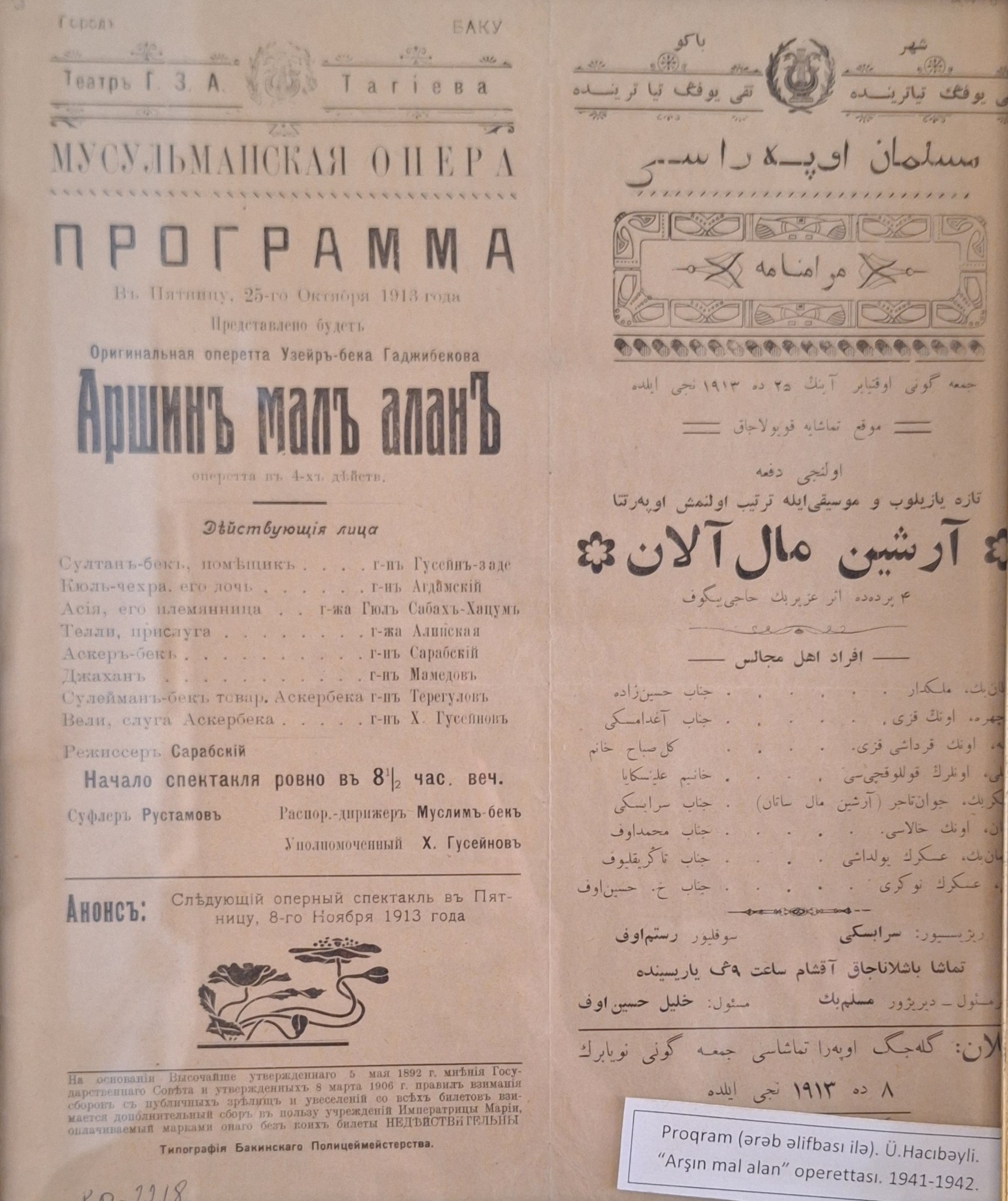 I wrote "Arshin Mal Alan" in 1913, when I studied at the St. Petersburg Conservatory. This is my last work written before the revolution. Its plot is taken from the life of Shusha, Garabagh. After "Arshin Mal Alan" was finished, I spent a lot of time and suffered a lot to obtain permission from the tsarist censorship to print and perform the work.
When this work was first performed in 1913, it was met with extreme disrespect and hatred by the Baku bourgeoisie's newspaper, "Kaspi." The "criticism" written about the work insulted the author. They accused this work of "inviting our girls to evil ways." These gentlemen, who described themselves as "supporters" of our daughters, sensed the blow inflicted on the Muslim religion and customs in this work. At that time, Azerbaijani girls were deprived of even the most basic rights. The purpose of writing this comedy was to promote women's liberation and expose old customs and traditions through a stage musical.
The types in the work were living people of that time, vital and real representatives of our society. The bourgeoisie, which ruled over society, saw its actions exposed in this work, so it tried to explain the idea of "Arshin Mal Alan" to the masses in a contradictory way to deflect the blow from itself.
Some idealized Asgar, portraying him as open-minded, a supporter of innovation, and a defender of culture. However, this was a completely wrong and false idea. Asgar is a man who views everything like a merchant. If he wanted to see the girl and marry her, it was not because he supported new beginnings, but because he was a merchant. He values the girl he goes to marry as much as the cloth worth 12 kopecks per arshin: just as the fabric can be pure and rotten, the girl can be blind, wrinkled, and unworthy of him. This is precisely why the merchant wishes to see the "goods" and buy them. And the daughter of a man like Soltan Bey! Otherwise, expecting ideas from Asgar, portraying him as an open-minded representative of society, is completely wrong. Asgar's friend, Suleyman, is also the son of a merchant. The difference is that he is a bit more agile and cunning, more skilled at getting things done and plotting.
Soltan Bey is one of the ordinary Garabagh beys. His every word and action depict his class affiliation. Conservatism has reached such a level in Soltan Bey that he dislikes engineers, doctors, and teachers.
Because these people who have found a place for themselves in high society due to their knowledge may also be from the lower class. Soltan Bey avoids their gathering. He spends his days in Sattar Mirzahuseyn's shop. He enjoys the company of representatives of commercial capital, such as the merchant Haji Mursal.
Gulchohra and Asya are Azerbaijani girls living under a veil between four walls. They are illiterate, uneducated, and deprived of love and of being loved. The issue that most interests representatives of this young generation, deprived of experiencing the pleasures of life such as reading, culture, public duty, and poetry in their entirety, is marriage.
- Who will be their future spouse?..
In the past, the "husbands" who turned the lives of Azerbaijani girls into dark days always made them ponder this issue. The good of husbands, the economic masters of the family, was considered happiness, and the bad was considered misfortune. Therefore, our girls, even those with a little imagination, like Gulchohra, wanted to see this future spouse at least.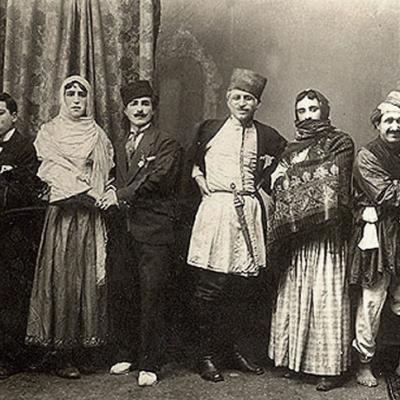
Asya, Telli, and the aunts lived entirely by luck, trust, and the help of messengers. The October Revolution consigned life in "Arshin Mal Alan" to the archives of history. Today's Azerbaijani youth view this life only as a historical event. Even though there are no arshinmalists in our lives now, such a work interests the audience. I think the reason for this is the reality and interesting content of the work.
The purpose of including it in our current repertoire is to introduce the younger generation to old life and to preserve the more or less good of our works written before the revolution.
A few months after its first premiere, "Arshin Mal Alan" was translated and performed in Russian, Georgian, Armenian, Greek, Persian, English, French, and more recently, Uzbek and Tajik languages. Since Azerbaijani-language works were not given significance in theaters before the revolution, they were not presented in their productions. Broken, mismatched scenery from the theater's warehouse was used.
The production of "Arshin Mal Alan" by Honored Artist and Director Comrade Hidayatzadeh at the Bolshoi Theater is superior to all previous productions. Because the director correctly understood the content and idea of the work, his interpretation also turned out to be correct. Comrade Hidayetzadeh did a great job with the artists. He was able to teach opera artists the technique of dramatic works.
Here, the images are realistic, and unnecessary embellishments are not allowed. Comrade Adham Sultanov, a young artist, put a lot of effort into the artistic design of the new production. All of the artist's work in the production leaves a beautiful impression. The view of the city of Shusha, especially in perspective, is artistic, charming, and correct.
As for the acting of our artists, it must be said that although Honored Artist Bulbul's role as Asgar seems a bit strange, he can cope with this task. Bulbul masterfully transitioned from the grand opera stage to a musical comedy role.
Our Honored Artist Huseynagha Hajibababeyov excellently performed the role of the trickster Suleyman. Due to Hajibababeyov's beautiful and charming voice, several musical numbers should be added to the role of Suleyman. Sona Mustafayeva and Saltanat Guliyeva play the role of Gulchohra, Aliya Teregulova and Elmira Akhundova play the role of Asya, and perform their roles well. It's hard to single out these young artists. All four of them deserve the same appreciation.
Alakbar Huseynzadeh, who played Soltan Bey for over twenty years, gained fame in playing this role and retained his previous skills, despite being an old actor. These words should also be said about Anatollu, who plays the role of Vali, because he still shows the same skills and temperament he demonstrated in the past as Vali. Telli, portrayed by Hagigat Rzayeva, is a true type of former servant. Needless to say, they played their roles well.
I sincerely thank our party and state for allowing the performance of my valuable old works. This gives me the spirit and energy to create new works that are national in form and socialist in content.
Uzeyir Hajibeyli. "Kommunist" newspaper, April 11, 1938.
The article was written during the preparation for the performance of the operetta "Arshin Mal Alan," which was included in the repertoire of the ten-day festival of Azerbaijani art held in Moscow (1938).