

Uzeyir Hajibeyli
"Husband and Wife"
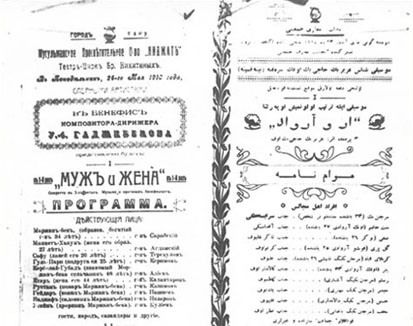 On May 24, 1910, in Baku, on the stage of the Nikitin Brothers' Circus, the premiere of the operetta "Husband and Wife" marked a new genre in Uzeyir Bey Hajibeyov's creative work. Consisting of three acts, "Husband and Wife" was the third stage work by our great composer. His earlier operas "Leyli and Majnun" (1908) and "Sheikh Sanan" (1909) both portrayed tragic love stories but had very different receptions. While "Leyli and Majnun" was met with great success and admiration, "Sheikh Sanan" faced indifference and disappointment. There were many reasons for this contrast.
The composer's sudden shift from lyrical, romantic operas to the comedic genre of operetta was unexpected to many. However, those familiar with Uzeyir Bey’s humorous, witty, and satirical writings—as a translator, feuilletonist, and editor—would not have been surprised. He had long been considered a disciple of the "Molla Nasraddin" school. The new operetta confirmed this impression.
Before its premiere, Baku newspapers had already started publishing articles about the work. On March 21, 1910, the newspaper "Haqiqat" wrote:
"Uzeyir Bey Hajibeyov, composer of the operas "Leyli and Majnun" and "Sheikh Sanan," has composed and written a new operetta—his third piece in this field. The operetta is titled "Husband and Wife." Its plot is humorous and morally instructive. The music is written for orchestra. Just as "Leyli and Majnun" was the first Muslim opera, "Husband and Wife" is the first Muslim operetta. While musically simple, it requires strong comedic performance skills."
The "Kaspi" newspaper, issue No. 115, dated May 23, wrote:
"We remind our readers that on Monday, at the Nikitin Brothers' Theater, the new operetta "Husband and Wife" by Uzeyir Bey Hajibeyov—the author of "Leyli and Majnun"—will be performed. The best opera artists will participate."
Interestingly, just a few years earlier, actors like Huseyngulu Sarabski, Mirzaagha Aliyev, who had performed in various productions as amateurs, Ahmad Agdamski, and Hanafi Teregulov—who had taken their first steps on stage through Uzeyir Hajibeyli’s operas, were by then unanimously recognized by Baku audiences as established opera artists.
The fact that "Husband and Wife" was written as a comedy also revealed new qualities in the opera performers. The hidden sense of humor in H. Sarabski, M. Aliyev, and H. Teregulov became a delightful discovery for the audience. Encouraged by putting them through this "test," Uzeyir Bey went on to compose his even grander operetta "If Not That One, Then This One" the following year.
Uzeyir Bey’s first opera, "Leyli and Majnun," had been supported by the "Nijat" charity and educational society in Baku, led by millionaire and philanthropist Isa Bey Hajinski. The society included prominent intellectuals, dramatists, actors, and writers. It organized benefit performances for famous artists and charitable purposes. "Husband and Wife" was also presented as a benefit performance for Uzeyir Bey.
On May 26, 1910, the "Kaspi" newspaper wrote:
"On May 24, at the Nikitin Brothers' Circus, the operetta "Husband and Wife" was performed as a benefit for the Muslim composer Uzeyir Hajibeyov. After the second act, he was congratulated on stage. The entire 'Nijat' society was present, and Mehdi Bey Hajinski congratulated Uzeyir Bey on behalf of the society, presenting him with an address, speaking about his contributions… After the speeches, he was given several valuable gifts… The operetta was well received by the audience."
The premiere’s director was Huseyn Arablinski, with Uzeyir Bey conducting. The lead roles were performed by: H. Sarabski as Marjan Bey, A. Agdamski as Minnat Khanim, M. Aliyev as Kabla Gubad, and H. Teregulov as Safi.
Several Baku newspapers praised the success of the operetta. "Husband and Wife" quickly became beloved by Baku’s public, and characters like Kabla Gubad and Marjan Bey became popular figures in everyday jokes and expressions.
Interestingly, pre-premiere articles noted that the operetta’s music was largely based on popular folk songs and themes, as well as excerpts from "Leyli and Majnun" and "Sheikh Sanan." This was true. The operetta was composed in a short time—only 2–3 months. Its music featured familiar melodies, which resonated with audiences.
Why did Hajibeyov include fragments from the failed "Sheikh Sanan" and the well-known "Arab Chorus" from "Leyli and Majnun"? It’s hard to say exactly, over a century later. Perhaps it’s not necessary to know. Time has spoken, and the past has become part of history.
The fate of "Husband and Wife" differed from that of Uzeyir Hajibeyli’s other works. While operas and operettas like "Leyli and Majnun," "Asli and Karam," "Koroglu," "If Not That One, Then This One," and "Arshin Mal Alan" have continued to be performed on stage to this day—bringing fame and affection to their creator—operas such as "Sheikh Sanan," "Rustam and Sohrab," and "Harun and Leyla" are known to contemporary audiences only by name.
The operetta "Husband and Wife," like Uzeyir Bey’s "Shah Abbas and Khurshidbanu", lived on stage for many years, was performed in various interpretations, and was loved by audiences—yet it suddenly slipped into the forgotten pages of history.
One might think that the later operettas created by Uzeyir Hajibeyli—such as "If Not That One, Then This One," and "Arshin Mal Alan", with their flawless, soul-soothing music and profound socio-philosophical content—had overshadowed and pushed it aside. But no! Despite the emergence of new works, "Husband and Wife" followed its path and continued its life on stage.
It was staged not only in Azerbaijan, but also in many cities across the South Caucasus, the Central Asian republics, and Turkey at various times. A document preserved in Uzeyir Hajibeyli’s house museum, dating back to the 1930s, reveals the desire to stage "Husband and Wife" at a state theater in Uzbekistan. During those years, the operetta was also part of the repertoire at the Musical Comedy Theater in Azerbaijan.
However, since the 1940s, except for a few amateur theater groups, "Husband and Wife" virtually disappeared from the stage. Interest in the piece gradually declined, and eventually, it faded from the audience’s memory and was forgotten. Although the operetta’s libretto was published several times, the musical and score materials were repeatedly lost, distorted, or rendered unusable. At the time, like most of Uzeyir Hajibeyli’s works, "Husband and Wife"had never been officially published and only survived in handwritten copies by various calligraphers, stored in scattered archives. And so, nearly 70 years passed.
In 2009—on the eve of the 100th anniversary of the first Azerbaijani operetta—the Azerbaijan State Musical Comedy Theater set out with the noble goal of bringing "Husband and Wife" back to the stage. To obtain the musical and score materials for the work, the only reliable source was approached: the composer’s house museum.
However, among the manuscripts preserved in the composer’s house museum, only an incomplete piano score and eight orchestral parts dating back to 1937 were found—insufficient for fully reconstructing the operetta’s complete score. The piano version included ensemble and choral parts in a single voice, and some musical numbers had tonal inconsistencies. All of this clearly demonstrated the necessity of a thorough revision of "Husband and Wife" and the complete rewriting of its piano score and orchestral parts. As both a composer and a Hajibeyli scholar, I had to take on this difficult and highly responsible task.
Recognizing the seriousness of the task ahead, we dedicated nearly a year to the restoration of the work. The entire process followed a series of structured stages.
- The vocal roles of the characters in the operetta were defined.
- Realistic tonalities were determined according to the voice distribution.
- The piano score was completely rewritten.
- Musical pieces were expanded, and choral parts were arranged in 4-part (mixed) and 2-part (male chorus) harmonies.
- Edits were made to the libretto.
- Errors made by past copyists in the piano score (scale, intonation, harmony issues) were corrected.
- Certain pieces that did not fit the style of the work were omitted.
- Several musical numbers that were absent from the earlier score were identified and added.
- A new orchestral score was written based on the new piano version.
- The revised piano score and orchestral score were digitized and edited again.
By the spring of 2010, on the 100th anniversary of "Husband and Wife", the operetta was once again brought to life on stage. The director of the Musical Comedy Theater, Aliqismat Lalayev, and chief director Yusif Akbarov approached the project with great enthusiasm. The main roles were performed with deep love and skill by People's Artists: Ilham Namig Kamal as Marjan Bey, Afaq Bashirqizi as Minnat Khanum, Yashar Nuri as Kabla Gubad, Arif Guliyev as Safi, and Fatma Mahmudova as Kabla Gubad’s wife. It was a performance by true stars. This production was especially significant in the stage careers of Yashar Nuri and Afaq Bashirqizi, as it marked their participation in all three of Uzeyir Hajibeyli’s operettas. At their request, the theater’s artistic council even approved the addition of a folk song to the scene between Kabla Gubad and Minnat Khanum.
The jubilee premiere held on October 4, 2010, was not just a celebration at the Musical Comedy Theater—it became a festive event in the cultural life of the entire country. The brilliance, diversity, and improvisational spirit inherent in Uzeyir Hajibeyli’s works gave the director, set designer, choreographer, and all the actors the freedom to approach their roles with vivid imagination and enthusiastic passion.
After a 70-year absence, "Husband and Wife" was reunited with its home stage. The production remains part of the Theater’s repertoire to this day and continues to be cherished and applauded by audiences.
The revival of the operetta "Husband and Wife" can be seen as the fulfillment of a moral duty to the spirit of Uzeyir Bey.
Amid the grand celebrations planned for the 130th anniversary of our great composer, the first official publication of "Husband and Wife" would undoubtedly be a worthy and highly valuable gift to the entire music and theater community.
Sardar Farajov
Director of Uzeyir Hajibeyov’s House Museum
Secretary of the Union of Azerbaijani Composers